
Getting a Police Clearance Certificate in Nepal
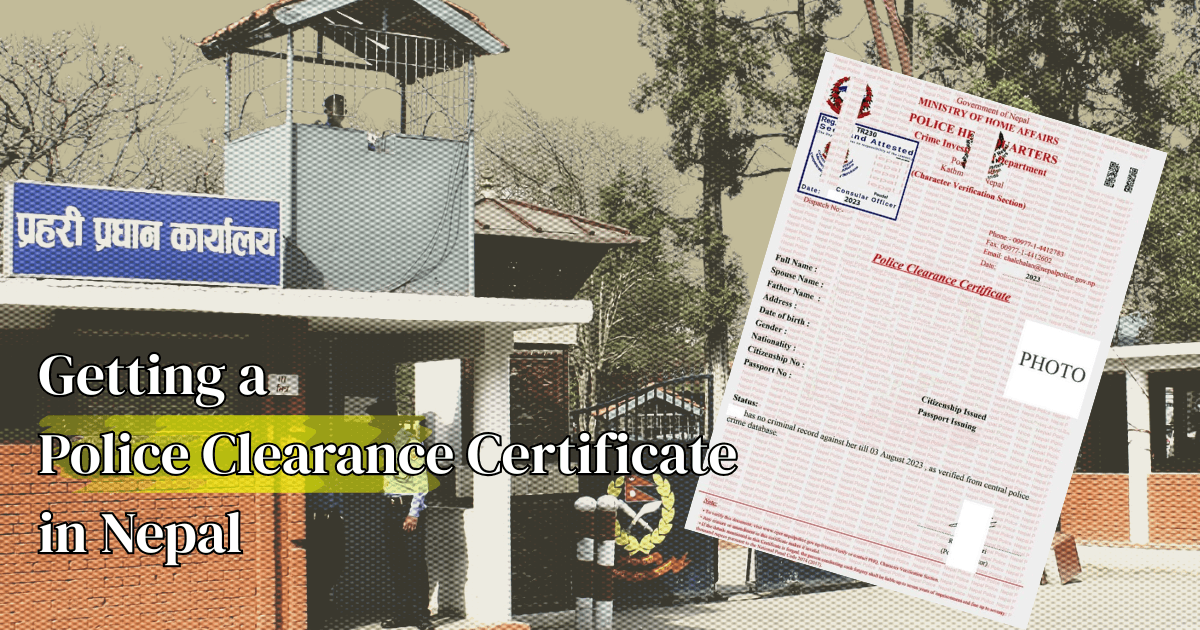
Most Nepali citizens applying for foreign employment, a long-term visa, or immigration may at some point be asked to produce a Police Clearance Certificate(PCC), also referred to as a Police Report or Character Certificate. It is a document issued by Nepal Police confirming whether the applicant has any criminal record in Nepal's Central Crime Database.
The certificate does not simply confirm the absence of any record. It also discloses the nature of the record, if any exists. The PCC carries a digital signature from Nepal Police and includes the applicant's personal details and photograph. Once attested, it is accepted by embassies, immigration departments, employers, and universities across most countries.
The most common situations that require a PCC are foreign employment in Gulf countries, Malaysia, Japan, or Europe; visa applications for UK, USA, Australia, or Canada; immigration and permanent residency applications; higher education abroad; adoption proceedings; Non-Resident Nepali (NRN) citizenship applications; and also by various regulatory authorities in Nepal, like Nepal Rastra Bank, Department of Land Management and Archives, while issuing permits or licenses. Some countries also require a PCC when registering a foreign marriage or applying for a spouse visa.
A PCC can only be issued by Nepal Police. No lawyer, notary, or third-party agent can issue or expedite one on an applicant's behalf.
How to Apply Online: The OPCR Portal and Nagarik App
The standard route for applying is the Online Police Clearance Registration (OPCR) system, available at opcr.nepalpolice.gov.np. It is free, can be used from anywhere in the world, and processes applications in 2–3 working days under normal conditions.
Once approved, the certificate is available to download as a digitally signed PDF with a QR code. Nepal Police does not issue paper copies from the office, so the downloaded PDF is authentic.
The Nagarik App also connects to the same OPCR portal. The process and outcome are identical to using the web portal.
The application process runs as follows:
Visit opcr.nepalpolice.gov.np and register using an active email address. The system sends a temporary password to that email.
After logging in and setting a new password, the application form opens across several steps (personal details, purpose of the PCC, residence information, and document uploads). On submission, the system generates a reference number that tracks the application's progress. Status updates are sent by both SMS and email, and applications show as Processing, Approved, or Rejected in the portal.
The name entered at registration must match the citizenship certificate exactly. The system does not allow corrections after registration. If there is a spelling difference between the name in the portal and the name on official documents, the account cannot be used, and a new one must be created with a different email address. Checking the name carefully before completing registration avoids this problem.
If an application is placed on hold rather than approved or rejected, it typically means the name submitted matches an entry in the criminal database. This does not necessarily mean the applicant has a record, but that the shared names are common.
The resolution is to visit the Character Verification Section at Nepal Police Headquarters, Naxal, Kathmandu, in person or through a representative, with a copy of the citizenship certificate and the application reference number. The section will verify identity and either clear the hold or advise on next steps.
Applying in Person
At the District Police Office
A PCC can also be obtained at the nearest District Police Office (DPO) by submitting a physical application. The applicant can collect the form at the office, fill it out, submit the required documents, and pay a fee of NPR 500. Processing through this way takes considerably depending on the district office and the verification workload. For applicants who are not comfortable with online applications or who need a physically processed certificate for a specific reason, this remains a valid option.
Through a Nepal Embassy or Consulate
Nepali citizens living abroad who need a formally processed certificate through diplomatic channels can apply at the nearest Nepali Embassy or Consulate. The embassy receives the application and documents, forwards them to Nepal Police for verification, and the completed certificate is returned to the applicant through the embassy office. This route typically takes 3 to 6 weeks, and fees vary by country.
For most people overseas, the OPCR portal is the faster and more practical route. It processes in 2–3 working days and requires no travel to an embassy. The embassy route is mainly used when an institution specifically requires a certificate processed through diplomatic channels, or when the applicant's circumstances make the online route difficult.
Documents and Fees
Documents required:
- Citizenship certificate (both sides: clear, complete scans for online applications)
- Valid passport (bio-data page: required for any international use)
- Recent passport-size photographs (2–4)
- A brief purpose statement explaining why the PCC is needed (employment, visa, immigration, education, etc.)
- Proof of current residential address
For the online application, scan quality directly affects processing. Blurry, incomplete, or inconsistently lit scans are among the most common reasons applications are delayed or rejected. All details across documents must be consistent. Discrepancies between the citizenship certificate and the passport, in particular, tend to cause holds.
Fees:
- Online application via OPCR portal or Nagarik App: free
- Offline application at District Police Office: NPR 500
- Attestation by the Department of Consular Services (required for international use): NPR 500, payable via eSewa, Khalti, or bank deposit
Validity and Using the Certificate Abroad
A PCC is generally valid for 3 to 6 months from the date of issuance. The certificate itself does not carry a printed expiry date, but what matters is the requirement of the receiving institution or country. Most visa and employment applications require a PCC issued within the previous 3 to 6 months. Confirming this requirement in advance avoids the certificate expiring before the application process is finished.
Attestation for international use:
Nepal is not a signatory to the Hague Apostille Convention, which means PCCs cannot be apostilled the way documents from Apostille-member countries can. For the certificate to be accepted in most foreign jurisdictions, it must be attested by the Department of Consular Services under Nepal's Ministry of Foreign Affairs. The attestation fee is NPR 500 and the process typically adds 1 to 2 working days. Payment is accepted through eSewa, Khalti, or direct bank deposit.
Some destination countries require an additional step i.e. legalization through the relevant country's embassy in Nepal, or through the Nepali embassy in the destination country. Whether this applies depends on the country and the specific institution requesting the document. Checking this requirement before initiating the attestation process saves unnecessary hassle.

Written by Summit Legal Advisory
Legal expert and contributing analyst at Summit Legal Advisory.