
Transfer of Land and Property in Nepal: A Step-by-Step Guide

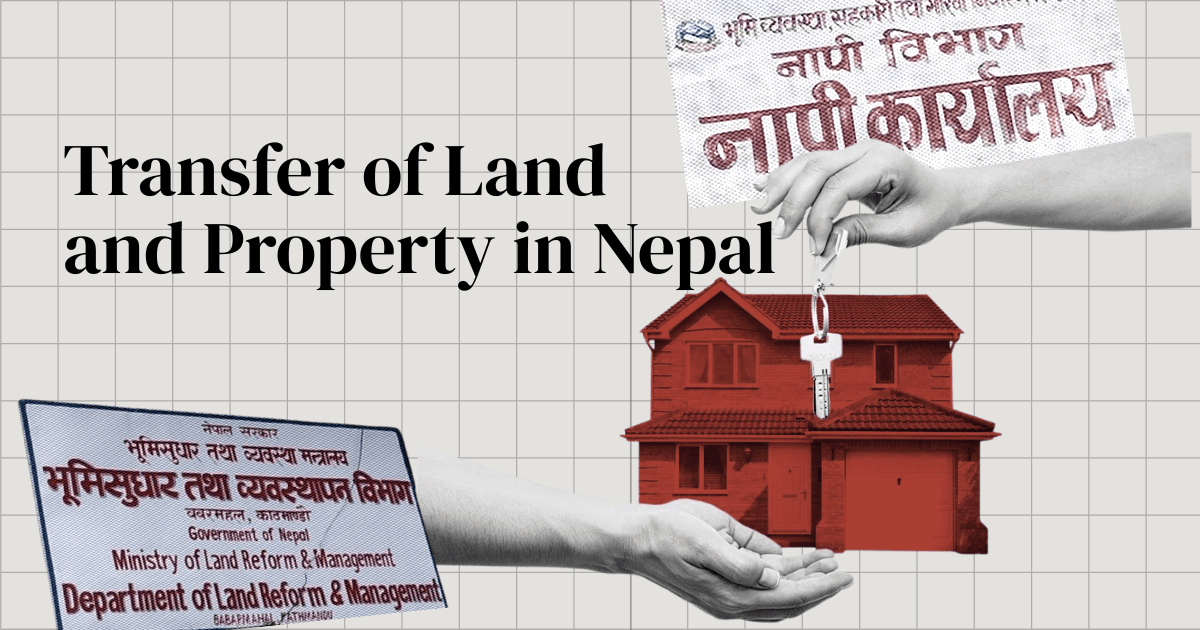
Buying or selling land is one of the biggest financial decisions most Nepali families make. The process at the Land Revenue Office can feel confusing if you have never done it before.
This guide covers what documents you need, which offices to visit, what taxes apply, and what tends to go wrong.
What Is a Property Transfer?
Land and property in Nepal are registered in government records under a specific person's name. When that land is sold, gifted, inherited or passed to a family member, the law requires those records to be updated to reflect the new owner. Until that change is made officially at the Land Revenue Office, the government still considers the previous person to be the legal owner.
The process is governed primarily by the Muluki Civil Code 2074 (2017 AD) and the Land Revenue Act 2034, along with applicable municipal and ward-level requirements.
Before You Start: Things to Check First
This step is often skipped and it is the source of most disputes.
Check the Lal Purja (लालपुर्जा)
The Lal Purja is the official land ownership certificate. Ask the seller to show you the original. Verify that the seller's name matches their citizenship certificate, the plot number (kitta number) matches what you are buying, and the land area is correct.
Check the Land Map (नापी नक्सा)
Go to the Survey Office (Napi Karyalaya) and ask for a blueprint of the land. This confirms the actual boundaries of the plot. Boundary disputes are among the most common problems in land transactions, and this step takes them off the table early.
Check for Encumbrances
Ask at the Land Revenue Office whether the land has any mortgage registered against it or is involved in any court case. If a bank has a loan registered on that land, you cannot complete the transfer without a No Objection Certificate from the bank first.
Check That the Land Is Not Government or Guthi Land
Government land and Guthi land cannot be sold to private individuals. If someone is offering you such land, do not proceed.
Verify the Seller's Authority
If the seller is acting through a representative using a Power of Attorney, confirm that the Power of Attorney is registered and still valid. Unregistered or expired documents have cost buyers real money.
Documents Required
The table below covers a standard sale between two private individuals. Requirements for inheritance, gifts, or corporate transfers differ and are noted separately.
Document | Who Provides It |
Original Lal Purja (land ownership certificate) | Seller |
Citizenship certificates of both buyer and seller | Both parties |
Passport-sized photographs of buyer and seller | Both parties |
Land tax clearance receipt (Malpot Rasid) | Seller (from ward/municipality) |
Ward recommendation letter (Sifarish) | From the local ward office |
Land measurement map / blueprint (Naapi Naksha) | From the Survey Office |
Transfer deed (Rajinama) | Prepared by a licensed deed writer |
Completed application form | From the Land Revenue Office |
Additional documents depending on your situation:
- Transferring to a spouse: Marriage certificate
- Transfer by inheritance: Death certificate, relationship verification, and heirship certificate
- If one party cannot appear in person: Registered Power of Attorney
- If the property has a bank mortgage: No Objection Certificate from the bank
- If the seller is a company: Company registration documents, MOA, AOA, board resolution, and PAN certificate
The Transfer Process
Step 1: Agree on Terms and Do Your Due Diligence
The buyer and seller agree on the price, the plot, and the conditions. This is also when the buyer should carry out the checks described above. Some people sign a preliminary agreement (Bainapatra) at this stage, which is a written commitment with an advance payment. A Bainapatra should ideally be registered to be legally enforceable, though many are still done unregistered.
Step 2: Get the Land Tax Clearance
The seller must obtain a land tax clearance receipt from the ward office or municipality. This confirms that all annual land tax (Malpot) has been paid to date. Unpaid dues must be cleared before the transfer can proceed. Some municipalities also require proof that house tax has been paid if there is a building on the land.
Step 3: Get the Ward Recommendation Letter
The local ward office issues a recommendation letter (Sifarish) confirming basic details about the property and that there are no local-level objections to the transfer. Routine, but it must be done before visiting the Land Revenue Office.
Step 4: Property Valuation
The Land Revenue Office uses a government-set minimum valuation rate for each area. Taxes are calculated on whichever is higher — the government's minimum valuation or the actual sale price stated in the deed. Declaring a price lower than the government rate does not reduce your taxes; they are still calculated at the government rate.
Step 5: Prepare the Transfer Deed (Rajinama)
A licensed deed writer (Lekhandas) prepares the transfer deed — the official document recording the sale. Both buyer and seller must sign it. This document must be prepared by a licensed deed writer in the prescribed format.
Step 6: Submit Documents at the Land Revenue Office
Both buyer and seller must appear in person at the Land Revenue Office (Malpot Karyalaya) of the district where the land is located. A transfer cannot be completed by sending someone else unless you have a registered Power of Attorney. Submit all documents to the officer, who will verify each one against the office records.
Step 7: Pay the Registration Fee and Capital Gains Tax
Once documents are verified, you pay the applicable taxes and fees at the office or at a designated bank counter.
Registration fee (paid by the buyer): Approximately 4% of the property value inside the Kathmandu Valley and 2% outside the Valley for transfers between unrelated parties. Reduced rates apply for transfers to close family members. Confirm the applicable rate with the Land Revenue Office or a lawyer before completing the transaction.
Capital Gains Tax (paid by the seller): Approximately 2.5% if the property has been held for more than 5 years, and 5% if held for less than 5 years. Rates may vary depending on whether the seller is an individual or a company, and on the applicable Finance Act for the current year. Verify with a tax advisor or the Inland Revenue Office.
Local development fee: An additional local-level fee of approximately 1.5% in many areas. Confirm the applicable rate at your ward office.
Step 8: New Lal Purja Issued
After payment is confirmed, the Land Revenue Office updates its records and issues a new Lal Purja in the buyer's name. Check all details — name, plot number, land area, and location — before leaving the office.
Taxes and Costs: A Summary
Cost | Who Pays | Approximate Rate |
Registration fee | Buyer | ~4% (inside Valley) / ~2% (outside Valley) |
Capital Gains Tax | Seller | ~2.5%–5% depending on holding period |
Local development fee | Buyer | ~1.5% |
Deed writing fee | Usually buyer | Nominal |
Land tax clearance | Seller | Any arrears owed |
The total cost to the buyer typically falls between 5–7% of the property value on top of the purchase price, depending on location and applicable rates.
Common Problems
1. Undisclosed mortgage on the land Some sellers do not disclose that the land has been used as loan collateral. Always check at the Land Revenue Office for any registered mortgage before paying anything.
2. Joint ownership not disclosed Land owned jointly by family members requires the consent of all co-owners for a transfer. If even one co-owner has not agreed, the Land Revenue Office will reject it. Ask the seller to confirm whether the land is jointly owned and get written consent from all owners.
3. Incorrect or outdated land map If the land's actual boundaries do not match the official map, the Survey Office may reject the measurement. Verify the Naapi Naksha before proceeding.
4. Tax arrears If the seller has not paid land tax for several years, clearing arrears can take time and add unexpected costs. Ask for the most recent tax receipt before agreeing on a price.
5. Minors as sellers A minor cannot legally sell land without court authorization. If the registered owner is under 18, the transfer process requires additional legal steps.
6. Guthi land sold without approval Guthi land has restrictions on transfer. Transfers made without proper Guthi Corporation approval are invalid.
7. Unregistered Power of Attorney If the seller sends a representative with an unregistered Power of Attorney, the Land Revenue Office will not accept it. Any Power of Attorney used for a property transfer must be registered.
Frequently Asked Questions
Can a foreigner buy land in Nepal? Generally no. Foreign nationals cannot own land in Nepal. There are very limited exceptions under specific investment laws, but these do not apply to standard residential or agricultural purchases.
Can I transfer land to my child as a gift? Yes. A gift transfer (Daanpatra) follows a similar process to a sale, but the deed type is different. Reduced tax rates typically apply for transfers within a close family. Both parties must appear at the Land Revenue Office.
What if the seller has died? The land must first be transferred to the legal heirs through an inheritance process (Anshaabanshilekh). Only after it is registered in the heir's name can it be sold to a third party. This requires a death certificate, relationship proof, and heirship documentation.
Do both buyer and seller have to come to the office? Yes. If one party cannot attend, a registered Power of Attorney is required — and the holder of that Power of Attorney must still appear in person.
What is a Bainapatra and is it legally binding? A Bainapatra is a preliminary sale agreement, usually made when an advance payment is given. If registered, it is legally enforceable. An unregistered one can still be used as evidence in a dispute but is harder to enforce. Registration is always advisable.
How long does the whole process take? A straightforward transfer with all documents ready can be completed in a single day at the Land Revenue Office. Gathering the documents (like ward recommendation, tax clearance, blueprint) typically takes one to two weeks. Cases involving inheritance, mortgages, or disputed boundaries can take months.
Conclusion
Property transfer in Nepal is not as complicated as it can seem. Once you know the sequence, it becomes manageable.
Do your checks before making any payment. Most problems in land transactions happen because buyers trusted verbal assurances rather than verifying the documents themselves. A little time spent at the Survey Office and Land Revenue Office before signing anything can save years of legal trouble later.
If your transaction involves inheritance, a company, a mortgage, or a Power of Attorney, consult a lawyer before proceeding. The cost of a mistake in property law tends to be high.


Written by Summit Legal
A Full Service Law Firm